




Germany is the largest economy in the EU and one of the most familiar jurisdictions for European counterparties. A German company can be suitable for trade, manufacturing, IT, logistics, consulting and local projects where a GmbH or the more compact UG form is useful.
Before registering a company in Germany, we compare the legal form, capital, city of registration, accounting, VAT position and expected payments. This makes it possible to calculate the first-year budget and prepare the corporate account documents in advance.
|
Official name:Federal Republic of Germany Area:356,910 sq. km. Population:current figures are published by official statistics Capital:Berlin Official language:German Currency:euro (EUR) Religion:Protestants, Catholics and Muslims |
 |
|---|

Australia
Austria
Bangladesh
Belgium
Bolivia
Brazil
Bulgaria
Canada
China
Czech Republic
Denmark
Ecuador
Egypt
Estonia
France
Italy
Hungary
Iceland
Indonesia India
Iran
Ireland
Israel
Ivory Coast
Jamaica
Japan
Kazakhstan
Kenya
Korea
Kuwait
Latvia
Liberia
Lithuania
Malaysia Malta
Mauritius
Mexico
Mongolia
Morocco
Namibia
Netherlands
New Guinea
New Zealand Norway
Pakistan
Philippines
Poland
Romania
Russia
Saudi Arabia
South Africa
Spain
Sri Lanka
Switzerland Thailand
Trinidad
Tunisia
Turkey
Ukraine
Uruguay
USA
Uzbekistan
Venezuela
Vietnam
Yugoslavia
Zimbabwe
CAPITAL GAINS TAX
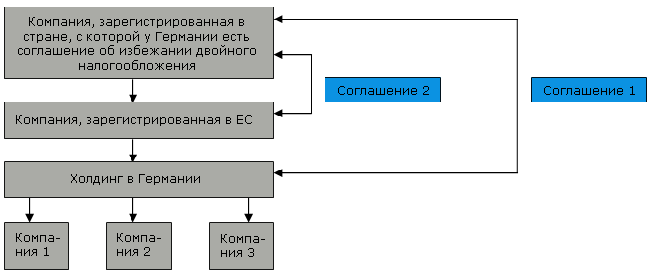
Capital gains are included in the German corporate tax system, subject to the applicable participation exemptions and special rules.
Gains from qualifying shareholdings may benefit from participation-exemption rules when the applicable conditions are met:
- Separate participation-exemption rules apply to dividends and capital gains of a German company. The participation percentage, holding conditions and Gewerbesteuer effect are checked separately for each subsidiary.
- the holding period and participation conditions are checked under the applicable rule;
- the nature and substance of the subsidiary’s activity may be relevant under anti-abuse, CFC and participation rules.
| COMPANY TYPE | GMBH |
|---|---|
| Typical formation time | 4 to 6 weeks |
| Cost | Registration, notary, Handelsregister, address and accounting costs are calculated according to the project and city of registration. |
| Minimum share capital | GmbH — EUR 25,000. A UG (haftungsbeschränkt) may be formed with lower capital, subject to its special reserve-building rules. |
| Capital structure | Divided into ownership interests according to the agreed contributions. |
| Nominee service | Yes |
| Paid-in capital | For a cash-formed GmbH, the minimum amount required by the GmbHG must be paid before registration; the total actual contributions must reach at least EUR 12,500. |
| Minimum number of shareholders | One |
| Minimum number of managing directors | One |
| Are corporate directors permitted? | No |
| Are local directors required? | No |
| Is a company secretary required? | No |
| Must meetings be held in Germany? | Yes |
| Is a local agent/office required? | No |
| Public register of directors | Yes |
| Public register of shareholders | Yes |
| Statistical reporting | Yes, filings are made with the company register as required. |
| Financial and tax reporting | Yes. Financial, accounting and tax reports must be filed with the relevant authorities. |
| Audit | For smaller companies, accounting can be handled by the company’s accountant or tax adviser according to the applicable German professional requirements. |
German tax law contains specific rules for transactions and structures involving related companies:
- Corporate-tax rules address hidden profit distributions, which can be treated as dividends for tax purposes.
- Germany’s international tax rules cover cross-border transactions between related parties and controlled foreign companies. CFC income may be attributed to a German taxpayer when the statutory conditions are met.
- The general tax code and international tax legislation contain anti-abuse and transfer-pricing rules. Related-party transactions are tested against the arm’s-length principle, meaning that prices should be comparable with those agreed between independent parties. Depending on the transaction, accepted methods may include comparable uncontrolled price, resale price, cost-plus and other recognised transfer-pricing methods.
| Parameter | Germany |
|---|---|
| Corporate income tax | 15% Körperschaftsteuer plus Solidaritätszuschlag; Gewerbesteuer is added at the municipal rate. |
| GmbH capital | EUR 25,000; for a cash formation, the required GmbHG portion must be paid before registration, with total actual contributions of at least EUR 12,500. |
| Dividends | Withholding tax and exemptions depend on the recipient, applicable DTT and EU rules. |
| Accounting | Annual accounts and tax returns are mandatory; audit requirements depend on company size and status. |
What changed in 2026 for company registration in Germany
In 2026, Germany is suitable for manufacturing, trade, e-commerce, IT, services and businesses that need their own company in the EU’s largest market. The main forms remain the GmbH with EUR 25,000 capital and the UG (haftungsbeschränkt), which can be formed with lower starting capital and then builds statutory reserves.
Taxation includes Körperschaftsteuer and municipal Gewerbesteuer, so the city of registration affects the final calculation. Before incorporation, we recommend defining the address, managing director, staff, accounting and expected tax registrations.
What activities is a company in Germany suitable for
A ready-made company registered in Germany or Germany GmbH registration under your own name is suitable for: trade, manufacturing, e-commerce, IT, services, holding structures and operating business in Germany.
Company registration: Germany GmbH and opening a bank account
First, we decide who will be the owner and director, the activities and company address, then prepare the documents for Germany GmbH registration. After company registration, we organise annual administration and accounting. To open a bank account or an account with a European payment system / EMI, we support preparation of contracts, service descriptions and information about expected payment countries.
A bank account for a company in Germany can be opened with a bank in a suitable jurisdiction, while an IBAN EUR/SEPA account can be opened with a European payment system / EMI. The application can be prepared remotely; when opening the account, we will propose accounts with banks for planned turnover and payments.
Key information about Germany GmbH
- Company form:GmbH, UG (haftungsbeschränkt), AG and partnerships
- Taxes:the financial model includes Körperschaftsteuer and municipal Gewerbesteuer, so the place of actual business affects the total tax burden
- Bank account:German bank for the main business; an EMI can be used as an additional EUR account.
- Cost:Basic company registration price is calculated according to the GmbH/UG form, notary, capital, address, accounting and tax registrations.
Additional information about a company in Germany 2026
Where to start to open a new company in Germany
Germany is especially suitable for a business that needs local clients, employees or a warehouse and a full EU presence. We can compare a GmbH and UG, calculate first-year costs and prepare the registration and account-opening process.
Choose a jurisdiction for company registration
Compare jurisdictions by registration options, taxes and reporting, annual maintenance and options for bank payments without currency control.
 Austria
 Belize
 BVI
 Canada
 China
 Cyprus
 Denmark
 Dominica
 EstoniaGermany
 Gibraltar
 Guernsey
 Hong Kong
 Hungary
 Jersey
 St Kitts and Nevis
 Labuan
 Liechtenstein
 Luxembourg
 Macao
 Malta
 Isle of Man
 Marshall Islands
 Mongolia
 Netherlands
 Panama
 Seychelles
 Spain
 St Vincent and the Grenadines
 Sweden
 Switzerland
 United Kingdom
 Uruguay
 United States